Showing posts with label UK. Show all posts

Monday, August 29, 2011

New Alien Beings Reported at Ilkley Moor, West Yorkshire


New Ilkley Moor Aliens Sighting

Click for video

Odd video surfaced recently that reportedly shows two aliens hiding among the rocks on Ilkley Moor. Ilkley Moor is part of Rombalds Moor, the moorland between Ilkley and Keighley in West Yorkshire, England, United Kingdom. The area is known for strange paranormal activity including a famous encounter in 1987:


A compelling account of alien abduction that took place in 1987 in the Ilkley Moor, Yorkshire, U.K....a unique case which may include one of the very few photographs taken of a live alien being. The main character and only witness of a UFO and alien being is one Philip Spencer, a retired policeman. He claims to have been taken aboard an unidentified flying object, and captured one photograph of an unknown being.

The Ilkley Moor:

Ilkley Moor is the highest part of Rombalds Moor, the moorland between Ilkley and Keighley in West Yorkshire, England, United Kingdom. The peat bogs rise to 402 m (1,319 ft) above sea level.

Ilkley Moor is very much like you would expect: a place of mystery and intrigue, and full of legends. There have been a number of reports of UFOs over the area, along with odd lights that seem to come and go. The lights, shining through the dense fog, can play tricks on the mind. There are two places where planes come and go-Menwith Hill Military Base, and Leeds Bradford Airport. Some of the strange sightings in the moor may be attributed to plane lights, but they will not explain what happened to Philip Spencer.

Spencer had worked as a policemen for four years in another location, but to fulfill his wife's wishes to be closer to her family, he had moved the family to Yorkshire. Spencer was taking a walk across the moor one December morning to his father-in-law's house, and was hoping to take some photographs of the strange lights on the moor. He had loaded his camera with ASA rated film to get the best quality pictures he could in the less than perfect lighting conditions. He could not imagine what was to soon befall him.

A Strange Looking Creature:


Spencer also brought along a compass to help find his way in the early morning hours before sun up. He was attempting to get some good angles for his photographs, when he saw a strange-looking being through the fog. The small being was on the slopes of the moor. Spencer took aim and photographed the small creature. He felt that the being was attempting to wave him away from the area. Whatever the being was, it ran away.

UFO Leaves Moor:


Spencer wanted to know more about what this strange being was, and what it wanted. He took off trying to catch up to it. Later, he would state that he must have just acted on impulse, as he had no fear of the unknown entity at the time. As he ran toward the being, he was stunned to see an unknown flying craft with a dome on top rising up from the moor grounds. It soon disappeared into the sky. He was not quick enough to photograph the UFO.

The photograph that Spencer took of the creature on the moor was very blurry, but it is still quite evident that there is some type of being present. The being very much resembles the so-called "grays" of UFO legend. Spencer waited for a time to see if the UFO or the alien creature might return, but all was quiet across the moor. He began to make his way to the nearest village, to get his photograph developed, and as he did, he noticed that his compass was pointing south instead of north. Arriving at the village, he noticed that his watch was an hour behind.

Photographic Analysis:


The photograph that Spencer took was first analyzed by a wildlife expert. He concluded that whatever was in the photograph was not any known animal. There was no way to ascertain if the subject of the photograph was a living creature or not just by looking at the picture. A recreation of the setting of the photograph was undertaken, and it was estimated that the creature was about four feet tall. An analysis of the photograph was done by Kodak laboratories in Hemel, Hempstead. They concluded that the object was indeed part of the original shot, and not added later.

The photograph was then shipped to America to be enhanced by computer, and analyzed. Dr. Bruce Maccabee, optical physicist with the United States Navy gave his expert conclusion:

"I had great hopes that this case would prove definitive. Sadly circumstances prevent it from being so."

Spencer made no money from his photograph, and relinquished all rights to the photograph to UFO investigators.

Further Information and Conclusions:

There have been numerous theories and much speculation about the Ilkley Moor photograph. Because of the poor lighting conditions present on the moor at the time the picture was taken, it was not possible to get a complete and definite conclusion. But with Spencer being a well respected man, and not given to making up stories, it can be said with certainty that Spencer lost about an hour in the moor, saw an unknown flying object of some type, and took a photograph of some unknown creature on December 1, 1987.

As Spencer regained his missing memories through hypnosis (read transcript below), he gave a fascinating tale of alien abduction. He was taken aboard the craft that he had seen lifting up from the Ilkley Moor. He was given medical-type examinations before being released. He could now remember that it was after his release from the UFO that he took the picture.

Climatic information gathered about the conditions of December 1, 1987, made it almost impossible for Spencer to have taken his picture at the time he had stated. However, if the regressive memories are accurate, the conditions would be right to duplicate the lighting conditions of the photograph, which was taken at least an hour after Spencer thought.

The witness of a UFO/alien event is as important as the report itself. The case of Ilkley Moor rides high on the character of Spencer. Through the years, Spencer and Hough became good friends, and still see each other from time to time. There has been no change in Spencer's account of what he saw that day.

He has sought no money from the case, and signed over all copyright privileges to Hough in early 1988. Spencer desires no fame from his account. Is the picture of the Ilkley Moor alien real or was it staged? There is no way to say, as the search for more information continues.
_______________________


CONTROVERSY and HYPNOSIS TRANSCRIPT


The case of the Ilkley Moor alien is one of the most controversial cases of alien abduction ever recorded in the U.K. because of the circumstances surrounding the event. At odds is the wide spread disbelief in alien abductions and the two very damning facts purporting it: the Ilkley Moor abductee was a police officer, expected to be an expert eyewitness, and the photograph of what he claims is the entity he encountered. Police officer Alan Godfrey claimed that he came across the being while crossing the Moor, in the county of Yorkshire on the morning of December 1st, 1987. He described the being as small, humanoid and green. He seemed to have startled the creature, for it took off running before halting at a safe distance and perhaps signaling him by bending it's right arm and raising it. Godfrey was carrying a camera and snapped a photo of the being, which seemed to have caused it to run off again, this time behind a large rock formation.

Godfrey gave chase, and as he rounded the rock formation he stopped dead in his tracks amazed at what was before him. A large gleaming silver domed metallic disc shaped craft stood in the clearing before him, and in an instant it shot off at incredible speed into the sky. Godfrey was unable to account for two hours after the encounter. Secondly, the photograph of the alien was badly blurred. Yet both the photo and the negative were examined by Kodak Film, which subsequently declared that the images had not been tampered with. Also, the officer noticed that his compass had switched polarity, it now pointed south instead of north.

The compass was examined by the University of Manchester's Institute of Science and Technology. Their conclusion: there were only two ways that this could have happened. Either the compass was inside a very strong magnetic field from a magnet, or had been subjected to a rapidly applied magnetic field or "pulsed" magnetic field generated by enormous amounts of electricity.

Godfrey decided to under go hypnotic regression to try and recount the missing time. Under hypnosis he was able to recount now that when he had come upon the silver craft in the clearing it had levitated him up inside of it. He described his captors as being about four feet tall "with big pointed ears and large black eyes....with three big fingers, like sausages." After apparently being examined by some type of "illuminating device" Godfrey was shown harrowing images of the earths environmental destruction. He was also shown another series of images which he absolutely refused to discuss, saying that he'd been sworn to secrecy.

Here is a transcript of the session:

JS- I want you to cast your mind back to the 1st December last year when you set off across the moor. I want you to clear your mind back to that and I want you to re-experience that. I want you to tell me what you experienced.

Spencer- I'm walking along the moor, oh! its quite windy. There is a lot of clouds. Walking up towards some trees. I see this little something, can't tell, but he's green it's moving up towards me. (We later found out that Jon had took the photo after his abduction and the creature was waving goodbye) Oh! I'm stuck I can't move and the creature still coming towards me. I'm stuck and everything gone fuzzy. I'm, I'm floating along in the air I want to get down! (He later told us he was levitated 2 feet off the ground and the creature was in front of him like a child pulling a balloon on a string). I still can't get down and I don't like it. I'm going round this corner and this green thing is in front of me. Oh God! I want to get down! (long pause) (breathing faster) There's a there is a big silver saucer thing there's a door in it. And I don't want to go in there. (worried sound in his voice) (sigh) Everything gone black now. (pause).

JS- you say everything gone black?

Spencer- Mmm! I can't see anything like I'm asleep, can't hear anything. (short pause) There's a bright light now. Can't see where it's coming from? I'm in a funny sort of room I can hear this voice saying don't be afraid. I don't feel afraid anymore. I can still see this green thing but I'm not afraid anymore of it. I'm being put on a table. I can move now if I want to, but I don't feel frightened any more and there's a beam like a pole it's above me it's moving up toward me. It's got a light in it like a fluorescent tube. It's coming up from my feet I can hear that voice again saying "we don't mean to harm you and don't be afraid." Makes me feel warm as it moves up me it's coming up over my stomach towards my head. Close my eyes I don't want to look at it in case it hurts my eyes. It's gone! (pause) there is something my nose feels funny (shows movement of nose) that's gone as well, I'm standing up now I don't know how I got stood up? I can see a door there is one of these green creatures motioning for me to come with him. Don't really want to go with him. I'd rather stay here I don't feel afraid in here (pause).

JS- Can you tell me what's happening now?

Spencer- I'm walking towards a door there is still a bright light there is light all around want to know where its coming from its just bright all around. Walking down a corridor there is a window. Oh! God!(sounds shocked)is that real? (deep sigh) (pause) (sounds afraid) don't want to be up here want to be down there? I can hear that voice again saying you've got nothing to fear. Its pretty though didn't realize it looked so pretty. (What Jon was looking at through the window was the earth seen from high in space just like the Apollo astronauts saw. Iv gone past the window now I'm walking down a corridor. (long pause)

JS- What's happening now?

Spencer- Come to the end of the corridor. There's a hole opened in it so I can walk through. I'm in a big room-a big round room, I'm on a raised platform against the wall. My camera and compass are trying to get away from me. Going towards the ball. It's difficult to pull them back down again, and this balls moved round with strange its got some blocks on it he says we cant stay in here to long he wants us to go out again the holes closed in the wall its gone strange he says I've got nothing to fear but Id still like to go home (pause) its got such big hands.

JS- What's happening now?

Spencer- Going down a corridor again. its very bright still I wish I knew where the light was coming from. And there is another door, going through a door it's an empty room two of those green creatures have come with me. there's a picture ,it's starting to move on the wall wonder how they get the pictures?

JS- Can you tell me what's happening at this point?

Spencer- I'm looking at the pictures on the wall. (long pause)

JS- Pictures on the wall?

Spencer- Mmmm. Creatures seem concerned at the damage that its doing. Picture changing now there's another picture, another film he's asking me a question he says do you understand? I said yes. It's time to go. Everything gone black. I'm walking up the moor again, I'm walking near some trees. Some movement - I can see something. A green creature. I've shouted to it. It's turned round. I don't know what it is. I'll photograph it it's turned around now. It's moving quick want to know what it is. I'm running after it, it's gone round a corner, I can't see it now. There's ... There is a saucer (laughingly), big silver saucer! It's disappeared? I'm walking on down gone past the trees.

JS- What's happening now?

Spencer- I'm going home. It's ten o'clock on the town hall clock. Can't really understand it was only eight o'clock.

JS- You mentioned some green creatures. Would you try to describe them to me?

Spencer- It's quite small. He's got big pointed ears, it's got big eyes. They're quite dark, he hasn't got a nose he's only got a little mouth. And his hands are enormous. And his arms are long. He's got funny feet.

JS- Funny feet?

Spencer- They're like a V shape like two big toes. Must be difficult to walk like that. He shuffles rather than walks. I don't feel afraid of him although he looks odd.

JS- You mentioned big hands? Can you say anymore about the hands?

Spencer- It's got three big fingers, like sausages. Big sausages. They're just very big. Bigger than my hands.

JS- About how tall would you say these creatures are?

Spencer- It's about four foot. Comes to the lump on my stomach. He's about as high as - just a bit bigger than my stomach is.

JS- Okay. Now I wonder if I can ask you another question? you mentioned a film?

Spencer- There were two films.

JS- Two films?

Spencer- One was lots of scenes of destruction like on the news. Can see lots of waste going into the river, and people like Ethiopians who are starving. It's not very good, it's not very nice.

JS- Want to say anything more about that film?

Spencer- It's much of the same thing, only different.

JS- What about the other film then? Do you want to tell me about it?

Spencer- I'm not supposed to.

JS- I'll leave that up to you entirely, do you want to say anything about that?

Spencer- I'm not supposed to tell anyone about the other film, it's not for them to know.

JS- Is there any thing more?

Spencer- No.

NOTE: over the years I have talked to several investigators about this case and the theories are all over the spectrum. The most prevalent thought is that this was not an actual alien and simply an anomaly caused by conditions on the moor. Though Spencer never sought compensation and was well regarded by people who knew him, the consensus is that overall, the story just doesn't add up. I have seen witnesses undergo hypnotic regression with a fair degree of success when a competent professional is running the session. If Spencer's regression session was legit, then I have to give his account the benefit of the doubt...Lon

Sources:
www.ilkley-online.co.uk
www.subversiveelement.com
ufos.about.com
ufocasebook.com
www.abovetopsecret.com
www.iwasabducted.com

VZMEDY385YCK

Sunday, August 21, 2011

Esoterica: The Pendle Witch Trial, Morrow Road Legend and Real Haunted Houses


The Witch Trial That Made Legal History


In recent years children as young as three have given evidence in court cases, but in the past children under 14 were seen as unreliable witnesses. A notorious 17th Century witch trial changed that.

Nine-year-old Jennet Device was an illegitimate beggar and would have been lost to history but for her role in one of the most disturbing trials on record.

Jennet's evidence in the 1612 Pendle witch trial in Lancashire led to the execution of 10 people, including all of her own family.

In England at that time paranoia was endemic. James l was on the throne, living in fear of a Catholic rebellion in the aftermath of Guy Fawkes' gun powder plot. The king had a reputation as an avid witch-hunter and wrote a book called Demonology.

"It was a mandate for the British to fight witches," explains Prof Ronald Hutton from the University of Bristol.

At the time Lancashire had a reputation for being full of trouble-makers and subversives. Jennet lived with her mother Elizabeth, her grandmother Demdike, older sister Alizon and brother James in the shadow of the Pendle hill. Villagers dubbed Demdike a "cunning woman".

In March 1612, Alizon cursed a pedlar who would not give her any pins. The pedlar collapsed and his son reported it to an ambitious local magistrate, Roger Nowell.

He interviewed Alizon, who confessed to bewitching the pedlar but also accused their neighbours, who the family were having a feud with, of bewitching and killing four people.

The neighbours pointed the finger straight back at Demdike, accusing her of witchcraft.

"Nowell was extremely zealous," says Prof Malcolm Gaskill from the University of East Anglia.

"He sees his route to success in his career is to identify non-conformists, that could be Catholics or witches, and bring them to justice."

He arrested Alizon, granny Demdike, as well as their neighbours Anne Whittle (also known as Chattox) and her daughter Anne Redferne.

Jennet's mother then hosted a party on Good Friday, when all "good citizens" should have been in church. A local constable heard rumours of a meeting of witches, so arrested everyone present. The family also implicated others and all were accused of trying to plot to kill a man using witchcraft.

Alice Nutter, from a respectable land-owning family, her sister-in-law, nephew and friend were among those arrested.

"At that time they were a strong Catholic family. I think [Nowell] thought he would curry favour with the King and the powers that be if he was catching Catholics as well," says Colin Nutter, a descendant of Alice who still lives near the Pendle hill.

"She was used as a pawn for his own ends really."

In his book Demonology, James l wrote: "Children, women and liars can be witnesses over high treason against God." This influenced the justice system and led to Nowell using Jennet as his key witness.

The clerk of the court, Thomas Potts, wrote a book of all the notes he made of the trial, which became a bestseller and spread the story far and wide.

In The Wonderful Discoverie of Witches in the Countie of Lancaster, Potts recounted how Jennet's mother Elizabeth screamed out when her daughter entered the court. Jennet demanded her mother be removed and then climbed on a table and calmly denounced her as a witch.

Her convincing evidence was believed by the jury and after a two-day trial all her family and most of her neighbours were found guilty of causing death or harm by witchcraft.

The day after they were hanged at Gallows Hill.

But Jennet's influence went far beyond Lancashire. Thomas Potts' writings and Jennet's evidence were included in a reference handbook for magistrates, The Country Justice.

The book was used by all magistrates, including those in the colonies in America, and led them to seek the testimony of children in trials of witchcraft.

So at the notorious Salem witch trials in 1692, most of the evidence was given by children. Nineteen people were hanged.

There had been earlier cases of children being witnesses in witch trials, but the law stated those under 14 were not credible witnesses because they could not be sworn under oath. Jennet's testimony changed all that.

Today children of any age can be called to give evidence as their competence depends upon their understanding not their age.

Ultimately though, Jennet fell victim to the very precedent she set herself in 1633.

Twenty years after the trial she too was accused of witchcraft along with 16 others by 10-year-old Edmund Robinson.

They were found guilty by a jury but the judges were not happy and it was referred to the Privy Council. England had become more sceptical over time and physical evidence was demanded.

Edmund eventually admitted lying because of the stories he had heard about the Pendle witch trial.

The last known record of Jennet Device was in 1636.

Despite having been acquitted she was not allowed to leave Lancaster Castle until she had paid for her board for the time she had spent there on trial. For someone like Jennet, that could have been impossible. - BBC

**********

A Haunting These Houses Go

“... Hill House, not sane, stood by itself against its hills, holding the darkness within... walls continued upright, bricks met neatly, floors were firm, and doors were sensibly shut; silence lay steadily against the wood and stone of Hill House, and whatever walked there, walked alone.” - Shirley Jackson, “The Haunting of Hill House”

I rather feel like Johnny Carson’s predecessor, Jack Parr, when he returned after an unscheduled time away from “The Tonight Show.” His first words when he returned were: “Now, as I was saying...”

Late summer and into the fall is a ripe time for haunted houses. What follows are accounts of real haunted houses, and a house that is apparently doing the haunting itself. That is, the house doesn’t have a ghost, the house is the ghost. See if you agree...

The first haunting is, without being too specific, way past the Dover gravel pit. (I don’t want to bother the current residents... if there are any.)

An older couple was living there at the time I write of, as I learned from my source, a local figure in the retail world, now retired.

The couple had been in the house for a while with nothing unusual happening but for whatever reason, they had not had cause to go down into the basement. One day, with nothing better to do while her husband was off fishing, the woman decided to finally explore the basement.

A light switch to the right of the stairs brought two dusty, barely adequate bulbs to life. Carefully negotiating the unfamiliar wooden stairs, the woman surveyed the basement and its concrete, slab floor. Ceiling high shelves of some vintage lined two of the walls. Several small crates and large, heavy cardboard boxes stood off to the left. A metal work table dominated the center of the basement. A metal storage cabinet stood to the right at the end of the shelves.

Seeing nothing of particular interest, though her husband might appreciate the tools she saw on the shelves, she turned to go back up when something near the metal cabinet caught her eye. She saw what appeared to be fresh, human footprints in the dust, those of a child of maybe ten or so. They led from the cabinet about six feet or so to the outer wall and stopped, as if whoever made them had walked through the wall.

Later, when her husband returned home, the woman told him of what she had been doing and about the footprints. He responded that no one had been down there since they had moved in, let alone a kid.

Going down to see for himself, however, he soon called back up to his wife at the top of the stairs. She went down and over to the cabinet, where he pointed at the floor. “This the place?” he asked. She nodded and looked down. Just dusty cement, no footprints.

The next day the man went down to do an inventory of the tools and glanced over to where his wife had thought she had seen footprints... and there they were; small, bare footprints of a child that disappeared at the outer cement wall.

Not computing for a long moment, the man, for some reason, reached over to the wall where an old broom stood and swept the footprints away.

As it turned out, a lot of the tools on the shelves were old, maybe from the end of the 19th or early 20th century; an antique dealer would pay a lot for them.

The prints reappeared once more as the man made several trips to gather the tools and again, he swept them away. He then locked the door to the basement and never went down there again. There was no reason to.

Perhaps even now, behind a locked door, small footprints march across a dusty floor and through the wall.

Our next little tale took place in Kootenai, not that long ago. A young couple with a two-year-old son moved into an older house, (naturally) and wondered at the odd attitude of the landlord. He seemed hesitant, even apologetic, without actually ever coming out and saying he was sorry about something.

The rent was great. The young man’s wages were not stellar, to say the least, and $550 a month for a four bedroom, two bath house was a dream.

The house was World War I era. Renovated in the 70s, there were nine rooms total and everything seemed great. Until the first day the young father went to work and his young wife began hearing... things. Just “noises” she would tell him when he came home from work. Like... she just didn’t know. Maybe whispering, coming from the walls and attic.

At first, he told her it was just nerves. She was likely imagining things because she was home alone all day with the responsibilities of a new mother. She needed to take the baby out, go to the library or to the newly opened Wal-Mart. Make some friends, whatever.

The young woman loved her man to pieces, but he was full of the old crapola.

A few nights later, the young father got up in the middle of the night for a drink of water; his sinuses had always bothered him. (Snoring dried them out.) And he heard... it, them, whispering in the walls. Voices like they were being screened through a mesh of wires and cheesecloth. He was unable to make out words, but they were human voices all the same.

The young family found a two bedroom apartment in Sandpoint the following month and the landlord of the old house became apologetic once more to another family.

You aren’t required to tell tenants or a buyer if a house is haunted, you see; you must only share whether someone died or was killed in the building.

The one time I went hunting with my friend, “Alex,” was like going hunting with comic Bill Engval. He is fun, and so was Alex.

But the next time Alex headed out, he was all alone. It was late October and he was a few miles west of town when he saw a modest-sized buck through the trees about a couple hundred yards away.

It was a crisp, forty-five degrees. Tree branches—a few birch supporting a few dry leaves that rustled in the wind—framed an increasingly dramatic October sky.

Following an old trail, Alex lost sight of his quarry, but something caught his attention.

Down to his right, in a valley of long shadows, barely visible in the waning light, was a house. “What the F---?” Dark gray, Alex could just make out the shutters of what was apparently the upper floors of a house. But out here, in the middle of the woods? Again, he thought to himself, “What the F---?”

Alex searched briefly for a way down, but there was no trail through the brush and trees. On top of that, the sky was becoming even more dramatic as heavier, dark clouds had begun to move in. Retreating the way he had come, Alex got back to his rig just before a cold, heavy rain started.

A mountain biker, (of which I proudly am one), told me several years ago that in late August a couple years earlier he had seen what looked to be an old Victorian-style house down in a hollow, but when he was on the same trail a few weeks later, he saw nothing but trees. From the description of the location, it sounded like the same trail that Alex had trod. I’ve also heard, second-hand, that two horseback riders saw something similar.

If you want neat, tidy explanations to end a story, rent a movie because this isn’t Hollywood! - by Lawrence Fury - riverjournal.com

**********

The Legend of Morrow Road

Morrow Road in Clay Township, Michigan has been known for it's horrifying legend and hauntings for over a century.

In 1893, during a snowstorm, a woman went out in the middle of the night searching for her toddler that had somehow wandered from the house. She was unable to find it and froze to death. It is said that the bodies were never found. But it is a fact that their spirits still haunt the road to this day. The area is also said to be ancient burial ground of the Indians.

The legend is if you drive out there at midnight, park on the old bridge, and honk three times, the woman will appear to see if you have her baby. She is described as wearing a bloody white gown and has a very distorted face with no eyes. If you try to flee from her, she will chase your car down the road and may even kill you.

Other eyewitness accounts have reported seeing glowing orbs in the woods, and the sounds of a crying infant near the bridge.

Skeptical of this whole legend, I got together with some friends and we drove out there one night in 1992. A night I will never forget. It was around 12:30 and pitch black. We got to the bridge and the hair on the back of my neck was standing. I felt like something was there watching us from the woods. We shut off the car and sat there for a minute. At the time, this was just a small one-lane dirt road with woods on both sides. There were no houses around. My friend honked the horn a few times and right away we heard the baby crying. It was coming from underneath the bridge. We got out of the car and I leaned over the guard rail. I could hear it crying, but couldn't see anything. Somewhere out of the darkness we heard a woman shout, "Where is my baby!!!"

That was it for me. I got in the car and my friends stayed out there goofing around. I saw a bright light come out of the woods and it came down the road toward the car. As it got closer, it winked out. My friends were getting spooked, so they got back in the car. They said they heard a woman screaming. We started the car, and before we could even take off, a silhouette of a woman came running out of the woods up to the car. My blood ran cold and I watched her fly right up to the driver's side window, I couldn't see her face, but saw her long hair.

My friend stepped on it and she pounded on the window as we sped off. We were going about 60 mph and one of my friends screamed. I looked back and the woman was right there looking through the back window. It seemed like forever, but we finally got off the road and the woman was gone by then. I will never go down that road again.

The road is now paved and the bridge was torn down. Houses are even being built.

**********


Pub ghost or trick of the light?

This picture apparently shows a ghost lurking in the doorway of The Wortley Arms, in Thurgoland.

It was taken by amateur photographer Paul Cocker who was shooting the 18th century building as part of his hobby.

He says it was only when he downloaded the photo he realised he appeared to have captured a supernatural being.

“I’m a rational bloke - I think a lot of this ghost stuff is claptrap,” the 41-year-old of Manchester Road, Deepcar, says. “But I have no answer as to what on earth this is.”

Trick of the light, per chance? Touch of photoshopping, maybe?

“Obviously when we get a photo like this sent to us the first thing we check for is evidence it’s been tampered with digitally,” explains Joe Collins, of Rotherham Paranormal. “If you check pixel definition you can usually tell and this certainly doesn’t appear to have been altered in any way.

“We’re looking into it but there are rumours the Wortley Arms is haunted – certainly it’s an old building with plenty of history. We’re planning a visit there to investigate.”

In the mean time, the advice to drinkers?

Keep a particularly close eye on your pints. - thestar

**********


What is Consciousness?

Black-Eyed Children

Ghosts and Cocktails

The Tortured Ghost of Jack the Ripper

The Haunted Road

Ghosts and spirits roam free at the Exhibition Grounds

The New NDE

'Psychic Kindergarten' Teaches Budding Mediums How to Explore Their Gifts

Psychic uses sixth sense to help solve crime

Haunted Hinsdale

Exorcist Schoolgirls

Ghost Stories and Haunted Places

8 Rules of Safe Spiritual Work

Spooked in the United Kingdom

Enlightened Rosary

Nowata Ghost Light

Black-Eyed Demon

Shrouded Deathbed Vision

Haunted by the Living

Haunted Sanctum of the Ancient Saxons

Contact From Beyond the Haunted Bunker

Why I Still Don’t Believe in Precognition

Thursday, August 18, 2011

London Hauntings & Spectres


Along with my passion for the paranormal and all things strange is my interest in Great Britain's history and mythology. I'm going to piece together many of the vintage tales and occasionally post these collections. Here is the link to the 1st post - British Monsters and Boogeymen. If you have a venerable narrative or anecdote that you'd like to share, please feel free to forward to me.

London's Phantom Hounds

A black hound was seen during the 1960s on the Wandsworth Road. Researchers attributed the form to the ghost of an animal killed on the road. The hound would often been seen disappearing into 523 Wandsworth Road. The haunting occurred for more than four months.

Similar harmless ghost dogs have been seen along the Thames. Phantom dogs are said to prowl a stairwell at Hampton Court, the Anchor Tavern on Bankside and the Spanish Galleon pub in Greenwich, which is apparently haunted by a large mastiff hound.

However, the lore of the black dog usually concerns more sinister beasts. At St Michael’s church, Cornhill (date unknown), a giant black hound appeared during a thunderstorm, entering via the south window, leaving claw marks scorched into the stone. A dog resembling a dachshund is said to haunt an area of Baker Street also.

But London’s most famous phantom hound is that which resides at the former Newgate Prison, a slithering, ominous spook which gives off a nauseating odor. Legend of the beast dates back to the reign of Henry III during a period of extreme famine when prisoners often fed upon one another. One victim of cannibalism, who was rumored to be a sorcerer, claimed vengeance upon the inmates when a frightful, red-eyed phantom hound materialized in the vicinity. According to legend, the evil beast ripped many of the felons limb from limb, its blood soaked jaws dripping onto the icy floor. Other prisoners simply died of fright, terrified of the oncoming sound of padded feet in the corridors.

The phantom hound was said to haunt the prison up until its demolition in 1902, yet sightings and strange odors are still reported, suggesting that this harbinger of doom is not confined to the dank annals of folkloric horror.

For some, black dogs are connected to dark deeds, appearing before a death or crisis whether in the form of extreme weather or disease. Many sightings occur on old roads, once believed to be ‘corpseways’ where funeral processions may have proceeded, and also near churchyards. Age old legends paint grim pictures of these beasts as the guardians of the gates of Hell. - paranormaldatabase.com

**********

The Phantom Horses of Windsor Park

I've often been intrigued by reports of phantom animals, especially horses when they are seen to be leading a carriage through some misty back road of a night. What perplexes me most is the fact that if inanimate objects have no souls, then why should the coach appear alongside the horses? And, if the horses never died together or with the coach, then why should they appear coupled in the ethereal void? Have there ever been sightings of a stagecoach drawn by nothing, or spectral horses drawing an invisible carriage? It seems not.

The huge gates of Black Horse Yard, at Windsor, are situated on the main Windsor to London road, which is flanked by houses built during the eighteenth century. It is here that one particular apparition is said to appear, ominously before the death of a monarch. A ghostly coach, and horses, is said to roar from the shadows where an old inn used to stand, and gallops towards the Windsor Park gates at great speed. Of course, no-one knows where the procession goes because it often fades into the gloom of night before its destination.

Rumor has it that the phantom carriage, pulled by two magnificent black horses, also consists of a third ghost, that being of a royal physician who was tending to King Charles II before his death. Although no relatively modern sightings of the spectral coach have been reported, its last appearance certainly suggests that, as a spirit, it is indeed an omen of death, because it was Edward VII who appeared gravely ill the last time the manifestation took to the streets.

However, this leaves the researcher with many unanswered questions. Does the spectral coach, the horses and the ghostly physician display some kind of intelligence beyond the comprehension of science and understanding? Or is the spooky scenario simply a continuous playback, embedded in the fabric of time to forever play back when a tragedy is about to strike?

These type of hauntings may suggest a mere recording of a past event, but if so, how on Earth does an historical gaggle of ghosts know when someone is going to die?

Whatever your belief, these historical enigmas continue to operate outside of their own timeline suggesting something, possibly in the human brain, triggers their existence. - Phantoms and Monsters

**********

The Ealing Horror

In the borough of Ealing, West London a photographer, keen to set up his own studio, moves into a half-derelict house. He brings with him his staff, who although slightly unnerved by the setting, settle in comfortably. Until that is, the noises start.

It wasn’t the studio that had such a hideous history, but it was the studio that succumbed to the activity. The peculiar noises coming from unoccupied rooms, the shifting of furniture when no-one was around, members of staff beginning to sense a presence, an unseen hand which tapped them on the shoulder or tugged at their garments, and those spectral voices from within the walls soon made this an awkward place to reside.

The photographer had a strong interest in the paranormal, as had many of his staff, and so, one evening, as darkness drew in, they decided to hold a seance, at least in the hope of communicating with some unknown form. To their delight, in some instances, they did indeed contact a spirit, but the eerie presence spoke of unrest in the neighboring building, a place that had seen much evil within its walls.

A lady and her very young child had been butchered in the property, and a man, belonging to one of the forces, was accused, found guilty and hanged for his crime. It was during this detail that the photographer began to feel sore around his neck, and felt that the spirit in contact with them was indeed the alleged murderer, and this was confirmed when the spectre pleaded its innocence.

Whether such an apparition was cast from the property we’ll never know, only persistent rumour or further experiences could shed some light on as to whether the property is still in turmoil. - ealinggazette.co.uk

**********

The Faceless Phantom of Langmead Street

The puzzled police stationed outside the house in Langmead Street couldn’t find an answer. They couldn’t explain the strange buzzing noises heard by 26-year-old Cecil Greenfield. They couldn’t find a suspect to arrest for the weird banging noises which kept the family awake every night. The family of eight were tormented by an unseen assailant who dragged furniture about the West Norwood residence. And then, at 2:15am on a warm July night in 1951, Dennis and his wife Gladys got the shock of their life when they entered their home and were confronted by a tall, grey figure without a face.

Inspector Sidney Candler was extremely skeptical of the fiasco until he heard the thumping noises coming from the attic, and was unnerved as a picture flew from the wall and smashed on the floor. Cutlery seemed to rattle in the drawers.

The house attracted many locals, some simply intrigued by the local haunted house, others more skeptical who howled abuse at the residents, shouting “Get your heads examined!” Even the relatives of the family were embarrassed by the situation and refused to aid the troubled family.

Father Alfred Cole of St. Matthew’s Church was called in to exorcize the building. It was the last resort for the family who’d been plagued by the noises all day, and every night. A group from the Church of the Nazarene held a vigil throughout the night, deep in prayer in hope of cleansing the house of its evil. And yet the activity refused to subside. If anything it increased.

The radio turned on by itself. Peculiar lights whizzed across the living room. A mattress lifted up and appeared to bend, and poor Dennis was accosted by an invisible intruder who tore his shirt.

The family had reached the brink. They fled. They were not followed by the spectres within.

A couple with four children moved into the property, fully aware of its reputation. They were never troubled by the phantoms, and the house on Langmead Street returned to normal. - gothamist.com

**********

Although the following narrative is not of a haunting or spectre, it depicts the fear in the streets of mid-late Victorian London:

London’s Garrotting Ghouls

London’s sinister folklore is peppered with tales of elusive killers, perverse slashers and stabbers, and all manner of peculiar assailants. These kinds of individuals, or groups, and their fiendish acts, often result in local panic and terror. Such creation of urban hysteria becomes legend. Take for instance the rumor that between 1856 and 1862, phantom garrotters were prowling the city streets.

These sadists were said to apprehend the victim, always from behind, bringing a forearm across the throat area of the prey. As the victim struggled, choking in horror, a vile companion would rob the accosted of all they owned. Victims never raised an alarm or pursued their attackers because this attack would often leave them semi-conscious.

In his fascinating book The London Monster, author Jan Bondeson writes: “…July 17, 1862, Mr Hugh Pilkington, M.P., was garrotted and relieved of his watch by two ruffians as he was walking from the House of Commons to the Reform Club.”

Of course, the fact that a leading citizen had been attacked by these mere rumored assailants, put the streets on high alert. Panic was in the air. Such sadists were perceived by the London press as some kind of inhuman race, said to lurk in the dingy shadows of dank alleyways, eager to feast upon their evil crimes, looting bodies as they lay almost choked to death.

Town folk brave enough to venture out after dark took to arming themselves with pistols and also home made weapons. Many believed that the garrotters were convicts who at the time were being released from prisons early for good behavior. If by some chance a garrotter was apprehended, there were immediate calls for the guilty to be hung or transported.

The spectral garrotters never truly existed but like so many other social panics, they emerged by way of society and its fears. Scaremongering emerged as local people feared the streets would become inhabited by criminals, released by overcrowded prisons. And as news spread about the liberal prison reforms, it was clear that any crime that hit the streets could be blamed on the alleged inadequacies of the prisons, as town folk boarded themselves in their homes for fear that London would be taken over by a multitude of stabbers, hackers, garrotters and repulsive rotters. - londonist.com

Saturday, August 13, 2011

British Monsters & Boogeymen


Along with my passion for the paranormal and all things strange is my interest in Great Britain's history and mythology. I'm going to piece together many of the vintage tales and occasionally post these collections. If you have a venerable narrative or anecdote that you'd like to share, please feel free to forward to me.

The Evil Black Hound

The old Newgate Prison harbors one of London’s most terrifying apparitions, that of an evil black hound. The legend dates back to the reign of Henry III, during a period of extreme famine, where prisoners were alleged to have gorged upon one another to survive! One of these victims was said to have been a sorcerer of the darkest arts, who claimed near death that he would seek revenge on the inmates. A fascinating account originates from the pen of a Luke Hutton, who was an inmate in the 1500s, and hanged in 1598. This oft-repeated version of the beast comes from 1638, entitled 'The Discovery of a London Monster' and reads as follows:

I maintained that I had read an old Chronicle that it was a walking spirit in the likeness of a blacke dog, gliding up and down the streets a little before the time of Execution, and in the night whilst Sessions continued, and his beginning thus.

In the raigne of King Henry the third there happened such a famine through England, but especially in London, that many starved for want of food, by which meanes the Prisioners in Newgate eat up one another altue, but commonly those that came newly in..there was a certain scholar brought tither, upon suspicion of Conjuring, and that he by Charmes and devilish Whitchcrafts, had done much hurt to the kings subjects, which Scholler, mauger his Devil Furies, Spirits and Goblins, was by the famished prisoners eaten up…


With vengeance promised by the prey: …nightly to see the Scholler in the shape of a black Dog walking up and downe the Prison, ready with ravening Jawes to teare out their bowles; for his late human flesh they had so hungerly eaten, and withal they hourely heard (as they thought) strange groanes and cries, as if it had been some creature in great paine and torments, whereupin such a nightly feare grew amongst them, that it turned into a Frenzie, and from a Frenzie to Desperation, in which desperation they killed the keeper, and so many of them escaped forth, but yet whither soever they came or went they imagined a Blacke Dog to follow, and by this means, as I doe thinke, the name of him began.

**********

The Highbury Hunchback

Mr Stock moved into his home in Highbury during 1849. Although the door number was 13, Mr Stock was not prone to superstition. And the overhanging trees and overgrown garden also did not deter Mr Stock. The rent was cheap, and that was the main thing.

Mr Stock employed a housekeeper, a Mrs Brown. Their first night at the property was a little strange, because as Mr Stock retired to bed, on passing a window he noticed not only his own reflection, but one of a very ugly, almost hideous looking man. Again though, Mr Stock had more important things on his tired mind. The following night whilst reading a magazine in bed Mr Stock dozed off but suddenly awoke. In the glow of the candle he noticed an old woman at the far end of the room. Eerily, the door began to open and the haggard figure slinked out the exit. Mr Stock’s yell alarmed Mrs Brown who comforted him but told him it was just a dream.

Two weeks went by without event, until that night he returned home from the theatre. With candle in hand Stock crept wearily upstairs. Staring once again, possibly by habit now, at the window, Stock noticed in the reflection that someone was following him up the stairs. Turning round he saw a terrifying apparition. A ghastly, wretched face almost obscured by a head of wild, shaggy hair. The figure had a hunched back, and its face was illuminated by some unnatural light. The sinister ghoul clutched a table knife in one dirty paw, and slowly ascended the stairs, step by step, towards the cowering Mr Stock.

Bizarrely, as the figure came closer, Stock realised that the monstrous spectre was completely oblivious to his presence, gliding by him on the stairwell and heading towards Stock’s bedroom. Stock, almost frozen with fear, found the strength and courage to follow the intruder. The beast reached the door, turned the door handle slowly and entered. Stock peered over the shoulder of the wraith at a distance, just in case the hunchback suddenly became aware of Stock, who clearly at this point was not on the same astral plateau.

Stock then saw the elderly woman he’d seen in the ‘dream’. She looked petrified as the hunchback leered with menace and approached her. Suddenly, the door slammed shut by the force of the wind. Stock reached for the handle, desperate to free himself from the horror about to unfold. However, when he quickly glanced back at the room, there was no terrified woman, and there was no evil hunchback. Stock ran downstairs and spent the remainder of the dark hours with gaslight in full flow.

Shortly after, Stock was brave enough to search the house but found no other presence or sign that anyone had been there. However, he did find that many years ago the house had been inhabited by a woman and her rather deformed son. Rumour had it that the woman left home and allegedly died abroad and the hunchback stayed in the house, never venturing in to daylight. Local word said that the reclusive figure then mysteriously vanished.

**********

Dragons Over London

Dragon-like ‘sky serpents’, which have also been connected to sightings of weird-shaped craft throughout history, have been occasionally seen over London. The Brentford Griffin, if genuine, was the last of the ‘dragon’ sightings, but a similar beast was spotted during the 1700s, and was mentioned in "The Gentleman’s Magazine":

“In the beginning of the month of August, 1776, a phenomenon was seen in a parish a few miles west of London, which much excited the curiosity of the few persons that were so fortunate to behold it. The strange object was of the serpent kind; its size that of the largest common snake and as well as could be discovered from so transient a view of it, resembled by its grey, mottled skin. The head of this extraordinary animal appeared about the same size as a small woman’s hand. It had a pair of short wings very forward on the body, near its head; and the length of the whole body was about two feet. Its flight was very gentle; it seemed too heavy to fly either fast or high, and its manner of flying was not in a horizontal attitude, but with its head considerably higher than the tail, so that it seemed continually labouring to ascend without ever being able to raise itself much higher than seven or eight feet from the ground.”

Even more amazing was the fact that the magazine recorded, in 1797, another flying serpent account, this time between Hyde Park Corner and Hammersmith, on 15th June late one evening. The witness, merely known as ‘J.R.’, wrote a letter describing the weird encounter, stating “…the body was of a dark colour, and about the thickness of the lower part of a man’s arm, about two-feet long.”

The witness continued, “…the wings were very short and placed near the head. The head was raised above the body. It was not seven or eight-feet above the ground.”

Whilst the creature seemed very life-like, and indeed almost like a flying snake, the letter ended in morose fashion, concluding, “…being an animal of such uncommon description, I was particular in noticing the day of the month, and likewise being the day preceding a most dreadful storm of thunder and lightning.”


**********

Spring Heeled Jack

One of the most curious and persistent of all paranormal creatures is Spring Heeled Jack. Reports of his existence date back to the early 19th century in Sheffield, England, and he has been reported on and off in England and the US as recently as 1995. And while a decent case can be made that the legend of Spring Heeled Jack is nothing more than a series of cruel hoaxes, it would represent a conspiracy of impressive scope and durability.

In 1808, a letter to the editor of the Sheffield Times recounted how "Years ago a famous Ghost walked and played many pranks in this historic neighbourhood." The writer went on to identify this entity as the "Park Ghost or Spring Heeled Jack," and briefly described its ability to take enormous leaps and frighten random passers-by, but concluded, "he was a human ghost as he ceased to appear when a certain number of men went with guns and sticks to test his skin."

The following is the chronicle of chaos:

September 1837 – Barnes Common. Over the course of two nights a businessman, and then three girls, were confronted by a fiery-eyed, darkly clad figure. The apparition tore at their clothes and laughed.

Early October 1837 – Cut-Throat Lane, Clapham Common. Mary Stevens, heading towards what was then Lavender Hill, was groped and kissed by a laughing maniac. The following night, a carriage on Streatham High Road was attacked by a creature. Both coachmen and the footman were injured in the crash. A woman walking near Clapham churchyard with her two sons observed a tall, thin and darkly clad gentleman who mocked them.

October 11th 1837 – Blackheath. Polly Adams was assaulted by a mysterious, bounding attacker, described as being cloaked, having glowing eyes and a mouth that spat blue flame. With iron like claws the assailant tore at her clothes, exposing her breasts, and then fled in a rapture of mocking laughter.

Late autumn 1837. Rumours of a stalking spectre at Hampton, Richmond, and Kingston.

Winter 1837. Two young girls were cornered in Dulwich; the clothes were ripped from one. In Forest Gate a couple were confronted; the man had his face slashed whilst a gypsy lady hampered the exploits of the criminal, calling for nearby help before the attacker could strike. He disappeared into the mist.

January 9th 1838. The Lord Mayor at Mansion House addressed the audience with mention of a disguised prankster, appearing also as a ‘ghost’, ‘bear’ and ‘devil’, claiming that the “unmanly villain has succeeded in depriving seven ladies of their senses”. In the same month, rumour spread that the ‘Peckham Ghost’ had attacked and killed in areas of Vauxhall, Brixton and Stockwell. In St John’s Wood the ‘monster’ attacked for two weeks and police believed the criminal would murder six women.

Late January 1838. The name Spring Heeled Jack was born, originating from his ways of leaping, described as ‘springald’ – a jumping jack.

February 1838. Sisters Lucy and Margaret Scales visited their brother Tom at Narrow Street, Limehouse. The girls left Tom at 8:35 pm, and as they walked along a dimly lit passageway, Lucy saw a fleeting figure, which then pounced. She was enveloped in his cloak, the glow of a lantern showing his mouth of blue flame. The figure vanished into the night. Two days later at the home of a Mr Alsop, a knock at the door during a late hour disturbed his three daughters, Mary, 16, Jane, 18, and the married Sarah. Jane went to the door and in the gloom of the shadows saw a tall, dark figure wearing a top hat. “I am a policeman,” the figure muttered, “for God’s sake bring me a light we have caught Spring Heeled Jack here in the lane!” he exclaimed. Jane hurried indoors to grab a candle but upon turning around was met by the figure the whole of London had become so fearful of. Again, his eyes were aglow, as was his flaming mouth. He wore a large helmet and tight fitting garb, and with razor claws slashed at Jane’s garments. It was sister Sarah who took on Jack, freeing her sister from his fateful grasp and then screaming for the police, sending the attacker of into the shadows. According to Mr Alsop, the fiend left his cloak behind.

February 27th 1838. A servant boy at Turner Street, off Commercial Road, answered the door to a figure with glinting claws and fiery eyes. The boy screamed and the form fled. The next day whilst under questioning, the boy claimed that upon the chest of the intruder he saw a breastplate showing off some ornate crest and also the letter ‘W’.

1839. Reports of bounding, fiery-eyed attackers come from as far afield as the Midlands.

Early 1840s. A cloaked, spring-heeled figure was rumoured to have terrorised the Home Counties.

August 26th 1843. A cloven-hoofed ‘Jack’ assaulted a man at Commercial Road. However, the victim fought back against the cloaked figure, even setting him on fire, although such a figure seems like a hoax.

November 1845 – Bermondsey. A springing, leaping figure was seen by several witnesses, bounding through Jacob’s Island. The figure then grabbed thirteen-year old prostitute Mary Davis on the bridge crossing Folly Ditch, spat flame in her face and then threw her into the murky depths where she perished. Her body was recovered and she became the first recorded victim of SHJ.

1870s. Reports from 1845 onwards seem a little vague. During the 1870s the ‘Peckham Ghost’ attacked a wagon at Lordship Lane, and was also seen at Dulwich College, but many of these figures seem to appear as pale imitations of the original, sinister terror.

1900s. SHJ haunted parts of Aldershot.

Spring Heeled Jack’s exploits, since their birth, have embedded themselves in world folklore with similar apparitions being sighted across the United States, South America, France and elsewhere in the UK. Many researchers believe that the Marquis of Waterford was the man behind the original London crimes, an eccentric Irish nobleman about whom author Peter Haining claimed, “the exploits of Spring Heeled Jack were wholly within his capabilities”, in his detailed book on the legend (The Legend and Bizarre Crimes of Spring Heeled Jack). Waterford died in 1859, although similar attacks occurred in Norfolk in 1877.

Some theorise that SHJ was an extraterrestrial, but whatever your beliefs on alien humanoids, this theory just doesn’t hold weight. Jack was also blamed for the mysterious set of footprints covering snowy Devon in 1855, which could not be attributed to any known animal or means of human capability.

Whether ghost, devil, serial killer or prankster, the crimes and events that many claimed were the work of the infamous shadow will always remain foggy, because, just like Jack The Ripper only a few decades later, Sweeney Todd, the London Monster previous, and many other puzzling mysteries, they are simply best left unsolved, even as they persist to the present day.

Sources:
londonist.com
www.thecobrasnose.com
"The Blacke Dogge of Newgate" - Luke Hutton - 1638
"Spring Heeled Jack: The Terror of London" - Anonymous
www.casebook.org
www.springheeled-jack.com
www.blackcatpress.co.uk

Tuesday, August 9, 2011

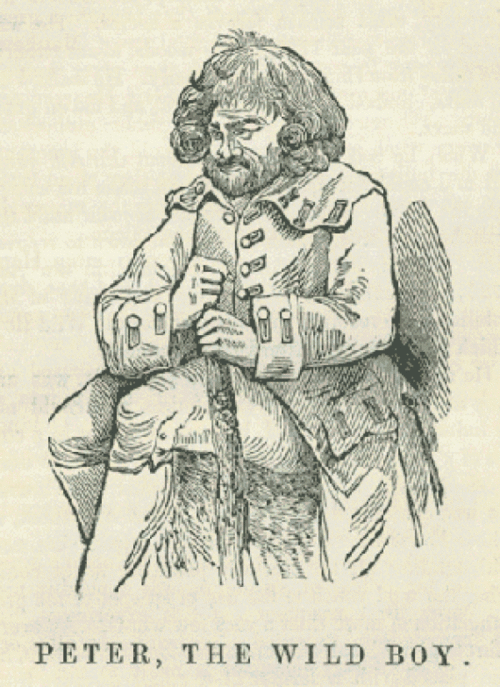
Peter, The Wild Boy of Hameln

In the summer of 1725 a peculiar youth was found in the forest of Hertswold near Hameln in northern Germany. Aged about 12, he walked on all fours and fed on grass and leaves. ‘A naked, brownish, blackhaired creature’, he would run up trees when approached and could utter no intelligible sound. The latest in a long line of feral children – in turn celebrated, shunned and cursed through the ages – ‘The Wild Boy of Hameln’ would be the first to achieve real fame.

After a spell in the House of Correction in Celle, the boy was taken to the court of George, Duke of Hanover and King of the United Kingdom, at Herrenhausen. There the young curiosity was initially treated as an honoured guest. Seated at table with the king, dressed in a suit of clothes with a napkin at his neck, he repelled his host with his complete lack of manners. He refused bread, but gorged himself on vegetables, fruit and rare meat, greedily grasping at the dishes and eating noisily from his hands, until he was ordered to be taken away. He was given the name of Peter, but was variously known as ‘Wild Peter’, ‘Peter of Hanover’, or, most famously, ‘Peter the Wild Boy’.

In the spring of 1726, after briefly escaping back to the forest, Peter was brought to London where his tale had aroused particular interest. As in Hanover, he caused a sensation and his carefree nature provided an amusing antidote to the stultifying boredom and decorum of court life. He appealed especially to Caroline, Princess of Wales, who persuaded the king to allow Peter to move to her residence in the West End, where he was kept virtually as a pet. Though he insisted on sleeping on the floor, he was dressed carefully each morning in a tailor-made suit of green and red. He was also appointed a tutor, who had him baptized and taught him to bow and kiss the hands of the ladies at court.

Peter quickly became a celebrity. On one level, tales of his antics busied the London gazettes. Jonathan Swift, whose fictional ‘Yahoos’ Peter appeared to personify, noted sourly that ‘there is scarcely talk of anything else’. He was soon the ‘talk of the town’, his portrait graced the walls of the King’s Grand Staircase at Kensington Palace and an effigy of him was erected in a waxworks on the Strand.

Peter could not to live up to the popular interest invested in him and a fickle public quickly abandoned him in favor of the next unfortunate. His academic progress also failed to match his earlier promise. He was declared ‘unable to receive instruction’, despite the attentions of ‘the ablest masters’. He could say nothing beyond his own name and a garbled form of ‘King George’. By 1728, his tutor had given up his efforts and Peter was retired to the country. A home was found for him on a farm near Northchurch in Hertfordshire and a generous crown pension of £35 per annum was supplied for his upkeep. The ‘talk of the town’ became a humble farm hand.

Though still only an adolescent, Peter faded into provincial obscurity and thereafter rarely troubled the gossip columns. He developed a taste for gin and loved music, reportedly swaying and clapping with glee and dancing until he was exhausted. But he never learned to speak and his lack of any sense of direction gave cause for concern. In 1745, the year of the Jacobite Rebellion, he was arrested as a suspected Highlander and, six years later, he wandered as far as Norwich, where he was thought to be a Spanish subversive. As a result he was fitted with a heavy leather collar bearing the inscription: ‘Peter, the Wild Man of Hanover. Whoever will bring him to Mr Fenn at Berkhamsted, Hertfordshire, shall be paid for their trouble.’ He died, aged around 72, in 1785.

The 19th-century German anthropologist Johann Friedrich Blumenbach (1752-1840) then rather spoiled the intellectual party. Examining contemporary accounts, which suggested that Peter had been tonguetied (hence his inability to speak) and had webbed fingers on one hand (a common corollary to mental impairment), he concluded that ‘the Wild Boy’ was most probably mentally retarded. If this was the case, he argued, it would help to explain Peter’s peculiar origins.

Rather than being a genuine ‘feral child’ then, Peter was most probably abandoned, possibly only weeks before his discovery. Most importantly, however, if he had been mentally disabled, then all the noble theories of development and socialization which relied on his example were rendered lame. The ‘noble savage’ had been a simple charity case, worthy of pity certainly, but not philosophical inquiry.

Feral children have always aroused man’s fascination. But when Peter stumbled out of the forest in 1725 he encountered a world in intellectual ferment. Inspired by the Light of Reason and the Scientific Revolution, Europe’s new secular intelligentsia was examining the world anew after centuries of obscurantism and superstition. An army of frustrated empiricists, they submitted everything and everyone to rational investigation. To them, Peter was a godsend: ‘the very Creature which the learned World have … pretended to wish for’. In a sense, the philosophers of the Age of Reason had met their match. They were faced with a man who did not make sense. But, for all their theories, it did not occur to them that he could not make sense – that there was no ‘sense’ to make.

Whatever his ailments, Peter was not forgotten by the royal court. His keep was paid by the crown for nearly 60 years through three reigns and when he died a brass tablet was erected to his memory at royal expense. But Peter was no more loquacious in death than he had been in life. He was given a prime spot in the graveyard at Northchurch, close to the south porch, and his rough-hewn stone, now shaded by an unruly dog rose, reads simply: ‘Peter the Wild Boy – 1785’. - excerpts from 'History Today' - Roger Moorhouse - 6/2010

-----

Peter the Wild Boy's condition revealed 200 years after his death

The condition that affected Peter the Wild Boy, a feral child found abandoned in a German forest and kept as a pet at the courts of George I and II, has been identified more than 200 years after his death.

Peter's charming smile, seen in his portrait painted in the 1720s by William Kent on the king's grand staircase at Kensington Palace, was the vital clue.

Lucy Worsley, the historian at Historic Royal Palaces who has been researching Peter's strange life, suspected from contemporary accounts that he was autistic.

She showed the portrait and gave the description of his physical characteristics and odd habits to Phil Beale, professor of genetics at the Institute of Child Health.

Beale ran the symptoms through his database of chromosomal disorders, and came up with a diagnosis of Pitt-Hopkins syndrome, which was identified in 1978, centuries after Peter's death.

Its most distinctive effect is clearly shown in Peter's portrait, his curvy Cupid's bow lips.

Other Pitt-Hopkins symptoms shared by Peter included short stature, coarse hair – the portrait shows him with a thick, curly mop – drooping eyelids and thick lips.

He was also said to have two fingers fused together, which may have been clubbed fingers, also sometimes a symptom.

His mental development would also have been affected. Together his symptoms explain to Worsley – who will discuss the discovery on the BBC Radio 4 Making History programme on Tuesday – how he ended up alone and naked in a forest.

"Certainly this was enough to explain why he was abandoned by his family, and once captured in the forest like a wild animal, why he was thrown into the local house of correction with the vagrants and thieves," said Worsley.

"He was actually quite lucky that King George I heard about him, and summoned him to court, even though there he was treated like a performing dog rather than a damaged little boy."

Worsley uncovered Peter's history while researching the courtiers and royal servants who appear in Kent's wall painting at Kensington Palace for her book Courtiers, published last year. The last piece of the puzzle has been solved now.

Worsley says she has been fascinated by Peter, who capered like Shakespeare's Puck in the solemn and etiquette stifled court. The servants had difficulty persuading him to walk instead of scuttling about on hands and knees, to sleep in a bed and to wear his green suit and red socks – he was terrified when he first saw a man taking off stockings, believing he was peeling off his skin.

George I gave Peter to his daughter-in-law Caroline, who was interested in science and philosophy, at a time when debate was raging about nature versus nurture, rational intelligence and the soul. He lived on at court when she became Queen.

Although he was treated kindly by his guardian, the Scottish doctor John Arbuthnot – by his side in the painting – he never learned to speak more than his name, and he wore a brass collar like a slave or a dog so he could be restored to his "owners" if he wandered off.

When he first came to England he was a media sensation in Georgian London, the subject of newspaper articles, poems and ballads – often satirising the extravagance and tortuous etiquette of the court. One mockingly described him as "The Most Wonderful Wonder that ever appeared to the Wonder of the British Nation".

When Jonathan Swift – suspected as co-author of the wonder pamphlet – was called to meet Caroline, he commented that since she was interested in a wild German boy, she also wanted to meet a wild Irish cleric.

Peter long outlived his royal patrons, and after Caroline's death in 1737 was sent to live on a farm in Hertfordshire owned by a retired courtier, where he lived into his 70s on a pension of £35 a year. He was buried in the churchyard of St Mary's at Northchurch near Berkhamsted, Hertfordshire. His simple gravestone reads: "Peter the Wild Boy 1785".

Worsley said: "He was a famous figure in Georgian times and he hasn't been forgotten today, people still lay flowers on his grave.

"It's hugely satisfying to winkle another secret out of the painting, which I've been obsessed with for some years now." - guardian

NOTE: I find the following narrative interesting and very telling of the period: To the thinkers of the 'Age of Reason', Peter represented a blank slate. As humanity in its ‘raw’ state, he was what Jean-Jacques Rousseau called ‘the noble savage’, man ‘unspoilt’ by society and civilization. He was indeed a fascinating subject, but he provoked further, disquieting, inquiry. He was undoubtedly human but, lacking speech and socialization, could he be classed as a man? Could he have a soul? Could he possess the power of thought?

Even though anthropology and the science of the human mind were in an early state at that time it makes one wonder how many people in our 'civilized' society (in particular those with power and wealth) still assume that those less fortunate, either physically or socially, should be seen and treated as secondary 'persons' who merely take up space.

I think we all know the answer...Lon


Photobucket
Spirit Rescue International™
Providing no-cost professional spiritual help, personal support and guidance
Take the first step towards genuine peace of mind


The Spirit Rescue International™ Haunted Help Forum
*Join Our Group On Facebook*


Join Eric Altman and Lon Strickler each Sunday at 10 PM ET as we go
Beyond the Edge!


Photobucket
ANOMALIST BOOKS
Works on maverick science, unexplained mysteries, unorthodox theories, strange talents, and unexpected discoveries. Please check out their excellent and diverse catalog


Become a fan of 'Phantoms and Monsters' at Facebook
Photobucket


"The latest news from beyond the mainstream"
Join Ben & Aaron for their weekly podcasts!
Check out Mysterious Universe Plus+ all access format!


Astral Perceptions - Discussing ultraterrestrial and multidimensional phenomena and the proficiency of remote viewing


Photobucket
Click here to check out Stan's most recent book!


Join the
The Social - Paranormal Network

A NETWORK OF INVESTIGATORS, ENTHUSIASTS AND THOSE SEEKING THE TRUTH
THROUGH PARANORMAL EDUCATION AND DISCUSSION


Photobucket
Need an unique special occasion or business gift?
(410) 241-5974


Amazing technology that allows us to print almost anything in light!


Click to order John Ventre's new book


Phantoms and Monsters
Now Available on Kindle

Tuesday, June 21, 2011

Locals Report Recent Loch Ness Monster Sighting

Foyers shop and cafe owner Jan Hargreaves and her husband Simon believe they caught a glimpse of Loch Ness’s most elusive resident — Nessie.

It was while taking a break on the store’s front decking — looking out to the loch — when Mrs Hargreaves and kitchen worker Graham Baine spotted an unusual figure cutting a strange shape through the water.

“We were standing looking out and saw something that looked bizarre,” said Mrs Hargreaves.

“I said to my husband to come and have a look.

“We stand here all the time and look out and we see boats and kayaks but it didn’t look like anything we have seen here before.”

Despite the unidentified creature being quite a distance from their vantage point, 51-year-old Mrs Hargreaves said it had a long neck which was too long to be that of a seal and it was black in appearance.

“It went under the water and disappeared for probably 30 to 40 seconds and then came back up again,” said Mrs Hargreaves.

“It was around for a good four to five minutes. It was just so strange.”

Keen to stress she is not seeking publicity, Mrs Hargreaves does firmly believe what she saw was the Loch Ness Monster.

“It was so exciting,” she declared.

Since August last year, The Waterfall Cafe and Foyers Stores with post office, opposite the village’s famous Falls of Foyers, has been run by Mr and Mrs Hargreaves.

Nessie hunter Steve Feltham, who lives in a former mobile library turned research centre on Dores beach, said he heard about the possible sighting when he popped into the store last week and believes because it was from residents rather than tourists, it is more credible.

“I’m excited by the fact it was locals who had seen it,” said Mr Feltham.

“It’s quite a distance from the shop to the water and they watch everything that goes on there.

“For them to be impressed then there is a possibility it could have been Nessie.”

What particularly excited Mr Feltham was that it was from the exact same vantage point where Tim Binsdale shot the best footage of the legendary creature back in 1960.

“I’ll put the sightings with the other sightings,” said Mr Feltham. “I will also continue to carry out surface observations.”

The sighting was recorded on Wednesday afternoon between 2.30pm and 3pm. - inverness-courier

NOTE: here are a few recent 'Nessie' related posts - Science Professor Believes Loch Ness Monster Family Exists - Retired Detective Insists 50 Year Old Loch Ness Monster Footage Authentic - Nessie Surfaces Again?...Lon


Photobucket
Spirit Rescue International™
Providing no-cost professional spiritual help, personal support and guidance
Take the first step towards genuine peace of mind


The Spirit Rescue International™ Haunted Help Forum
*Join Our Group On Facebook*


Join Eric Altman, Lon Strickler and Sean Forker LIVE each Sunday at 10 PM ET as we go
Beyond the Edge!


Photobucket
ANOMALIST BOOKS
Works on maverick science, unexplained mysteries, unorthodox theories, strange talents, and unexpected discoveries. Please check out their excellent and diverse catalog


The 'C' Influence
Actualizing Esoteric Discussion


Become a fan of 'Phantoms and Monsters' at Facebook
Photobucket


"The latest news from beyond the mainstream"
Join Ben & Aaron for their weekly podcast!
Check out Mysterious Universe Plus+ all access format!


Astral Perceptions - Discussing ultraterrestrial and multidimensional phenomena and the proficiency of remote viewing


Photobucket
Click here to check out Stan's most recent book!


Join the
The Social - Paranormal Network

A NETWORK OF INVESTIGATORS, ENTHUSIASTS AND THOSE SEEKING THE TRUTH
THROUGH PARANORMAL EDUCATION AND DISCUSSION


Photobucket
(410) 241-5974


Phantoms and Monsters
Now Available on Kindle